
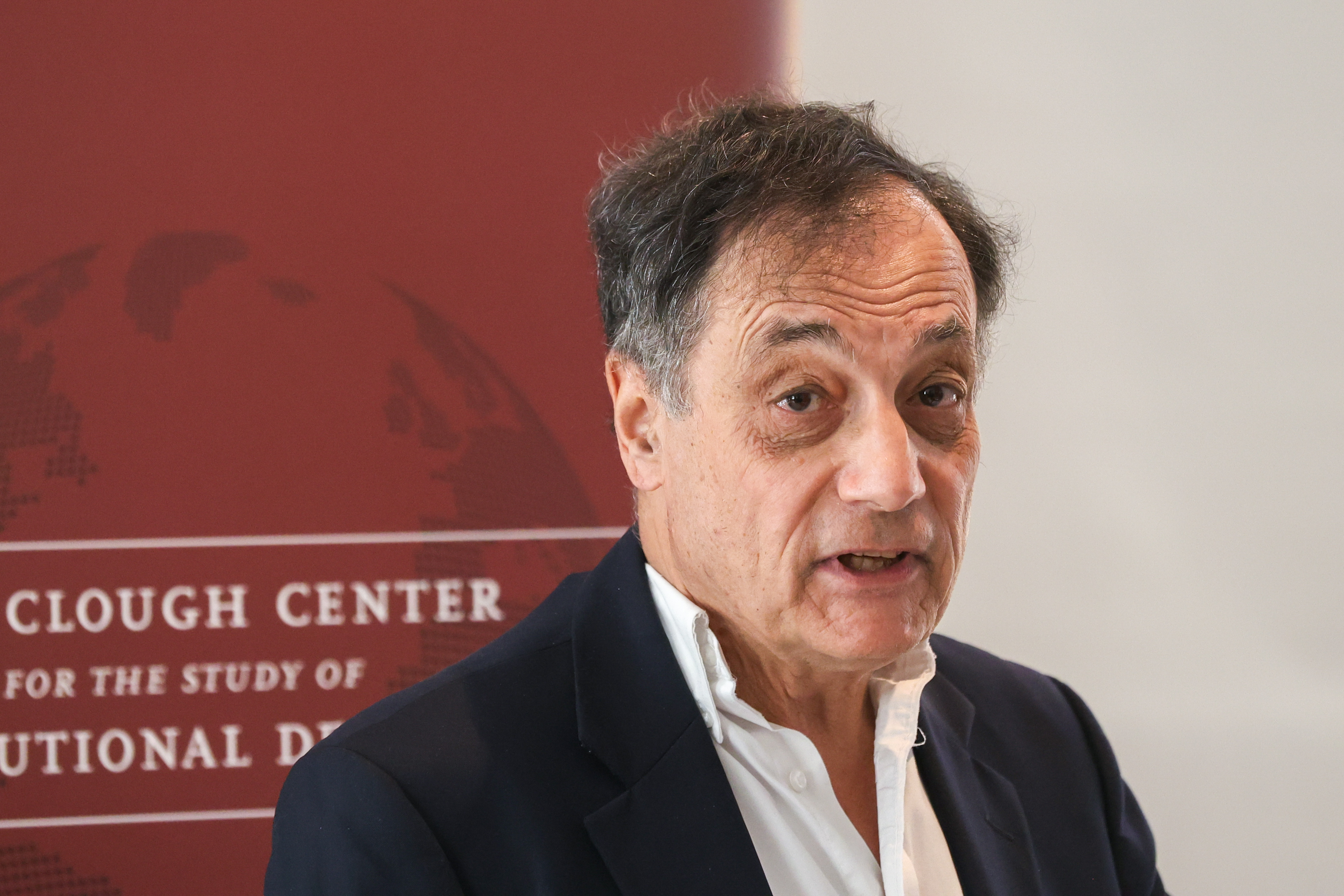
We are extremely pleased to share a brief review by Professor R. Shep Melnick of Harvey C. Mansfield’s America’s Constitutional Soul, which Professor Melnick has named his favorite book on constitutional democracy. Professor Melnick is the Thomas P. O’Neill, Jr. Professor of American Politics at Boston College and co-chair of the Harvard Program on Constitutional Government. He is the author of The Crucible of Desegregation: The Uncertain Search for Educational Equality (University of Chicago Press 2023) and The Transformation of Title IX: Regulating Gender Equality in Education (Brookings 2018). Professor Melnick has also spoken at many Clough Center events, including the 2025 Spring Symposium.

Recently, the Clough Center asked several leading scholars on campus to name a favorite work on constitutional democracy. We are grateful for Professor Melnick’s thoughtful response and pleased to present it here:
“My choice is an unusual one: America’s Constitutional Soul by Harvey C. Mansfield, Jr. (Johns Hopkins University Press, 1991). This is a short book by a political theorist not generally thought of as a constitutional scholar. But it is the most profound explanation I have ever read of the meaning of constitutional government. Mansfield moves back and forth between everyday politics—presidential elections, the debate over affirmative action—and the political theory of Hobbes, Locke, Tocqueville, The Federalist, Machiavelli, and Aristotle. He criticizes political science’s thin understanding of constitutions, contrasting it with Aristotle’s conception of a constitution that both incorporates and shapes our aspirations. A constitution will have staying power only if it is not just a set of rules, but inculcates in its citizens and—most importantly—its leaders a particular ethos. It is formative; it establishes standards by which we judge ourselves and which we are expected to live up to. As both Lincoln and Martin Luther King, Jr. emphasized, our written Constitution, for all its flaws and compromises, is an effort to form a government consistent with the principles announced in the Declaration of Independence. This short book explains why a political science ignorant of the greatest political theorists will fail to understand its subject; and why political theorists can better understand their subject by confronting issues in contemporary politics.”

About The Author




Leave a Reply