

Author: Madeline Carr (Clough Correspondent, Political Science Student)

Madeline “Maddy” Carr
Clough Correspondent, Major in Political Science and History, and Minor in African and African Diaspora Studies at Boston College.
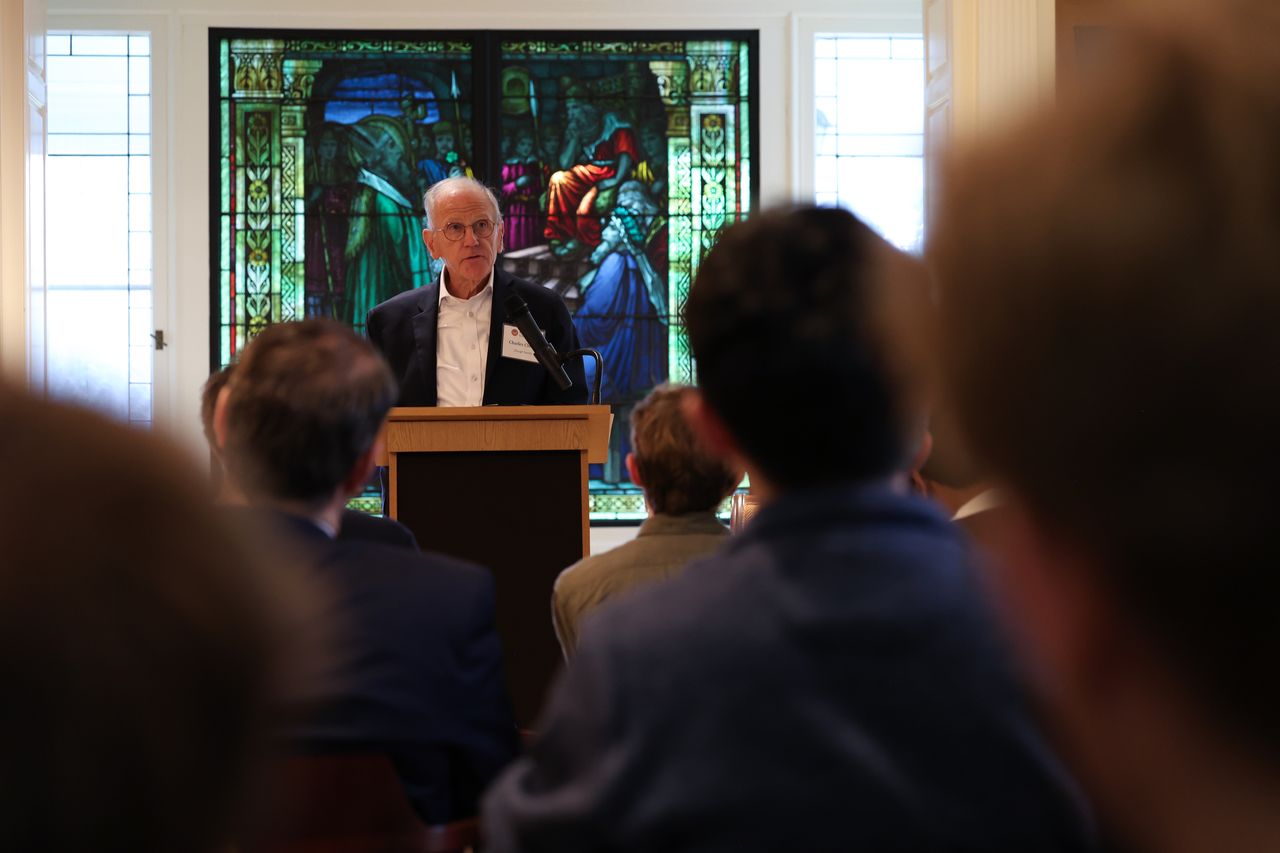
At our 2026 Spring Symposium, Nadine Strossen, the former president of the American Civil Liberties Union (ACLU) (1991 to 2008), and the John Marshall Harlan II Professor of Law Emeritus at New York Law School spoke in-depth about the complex nature of free speech within the context of democratic resilience. Strossen’s panel was moderated by the Clough Center’s Postdoctoral Research Fellow, Isaiah Sterrett. Sterrett began this discussion by asking Strossen, as a lawyer and an activist – why speech? Strossen replied, saying that she believes freedom of speech is a prerequisite for all other civil rights.

While the freedom of speech may seem simple, the central question of this panel revolved around appropriate limitations for this fundamental right. Strossen highlighted “viewpoint neutrality” as the “bedrock principle of free speech,” meaning that matters of “interpretation, perspective, analysis, and opinion” are protected under freedom of speech. However, if “objectively verifiable or falsifiable facts” cause specific harm, they are not protected. Instances of perjury, fraud, and defamation fall under this umbrella, according to Strossen.
She stated that free speech is not absolute. Instead, it’s common sense-based and “does empower the government to outlaw the speech that is more dangerous.” While maintaining viewpoint neutrality, “If you get beyond the view of the speech, [or] the content, and you look at it in its overall context, and in the particular facts and circumstances, [if] it directly causes or imminently threatens certain specific harms, it can and should be restricted.” This would satisfy the “emergency principle.”

But how do you quantify harm? This gets quite complicated when it comes to defending organizations that promote hateful rhetoric but may not be explicit about violent intentions. Strossen mentioned the legal disputes that arose in the late 1970s around a push by a group of neo-Nazis to demonstrate in Skokie, Illinois. In those cases, the ACLU supported Nazi sympathizers as they protested in an Illinois suburb with a high population of Holocaust survivors. While it may have been “easy” for the courts to decide Nazi rhetoric was protected, this decision was extremely unpopular with the public. In its aftermath, Aryeh Neier, the executive director of the ACLU, wrote a book titled Defending My Enemy: Skokie and the Legacy of Free Speech in America.
How can the organization that supported the Black Panthers and the greater Civil Rights Movement of the 1960s also advocate to protect the speech of white supremacist and antisemitic organizations? In 2017, during the Charlottesville Unite the Right rally, the ACLU doubled down, defending the protestors. They argued that, although Heather Heyer died and many were injured, the police found no explicit intention of violence when monitoring the group. The ACLU received less backlash from the public this time around, but more internal dissatisfaction, with a board member from Virginia publicly resigning and writing to The New York Times about the incident.
While there may appear to be ideological dissonance in the causes the ACLU chooses to support, Strossen believes that protecting freedom of speech is what allows progress. Referencing a statement made by the Supreme Court, Strossen remarks, “we support freedom of speech, not despite the fact that it can do harm, but precisely because of that fact. Speech can do harm because it’s so powerful, but it is a power that can be harnessed for great good as well as great harm.” She claims that, because of the weight of our words, restricting expressive exercises that go beyond the scope of free speech is just as important as protecting expressive exercises that stay within these principles.


While it is clear that Strossen and the ACLU believe that freedom of speech should apply equally to all individuals equally, regardless of perspective, I would appreciate a more detailed explanation of what constitutes “harm.” I could easily make an argument that a swastika is a symbol of violence and a threat to survivors of the Holocaust, and I do not think protecting Black Panthers or Civil Rights Activists is a fair comparison to protecting Nazis. Even though the Black Panthers were a militant group, their platform relied on self-defense in their fight for equality, while the Nazis fought to maintain supremacy over a marginalized ethnic group recovering from mass genocide. The swastika symbolized eugenics, death, and white supremacy.
Strossen cited a FIRE Survey in which 40% of students believed that words are violence, and about a third of respondents believed that violence is sometimes justified to silence those you don’t agree with. After the assassination of Charlie Kirk, these statistics increased nationwide, except at Utah Valley University where Kirk was killed. While I certainly do not agree with the death of Charlie Kirk or the idea that violence is justified to silence those you disagree with, I do believe that words can be violent. For me, quantifying “harm” sits at the center of this debate, which makes definitive conclusions about what is and is not protected extremely complicated.
About The Author



Leave a Reply