

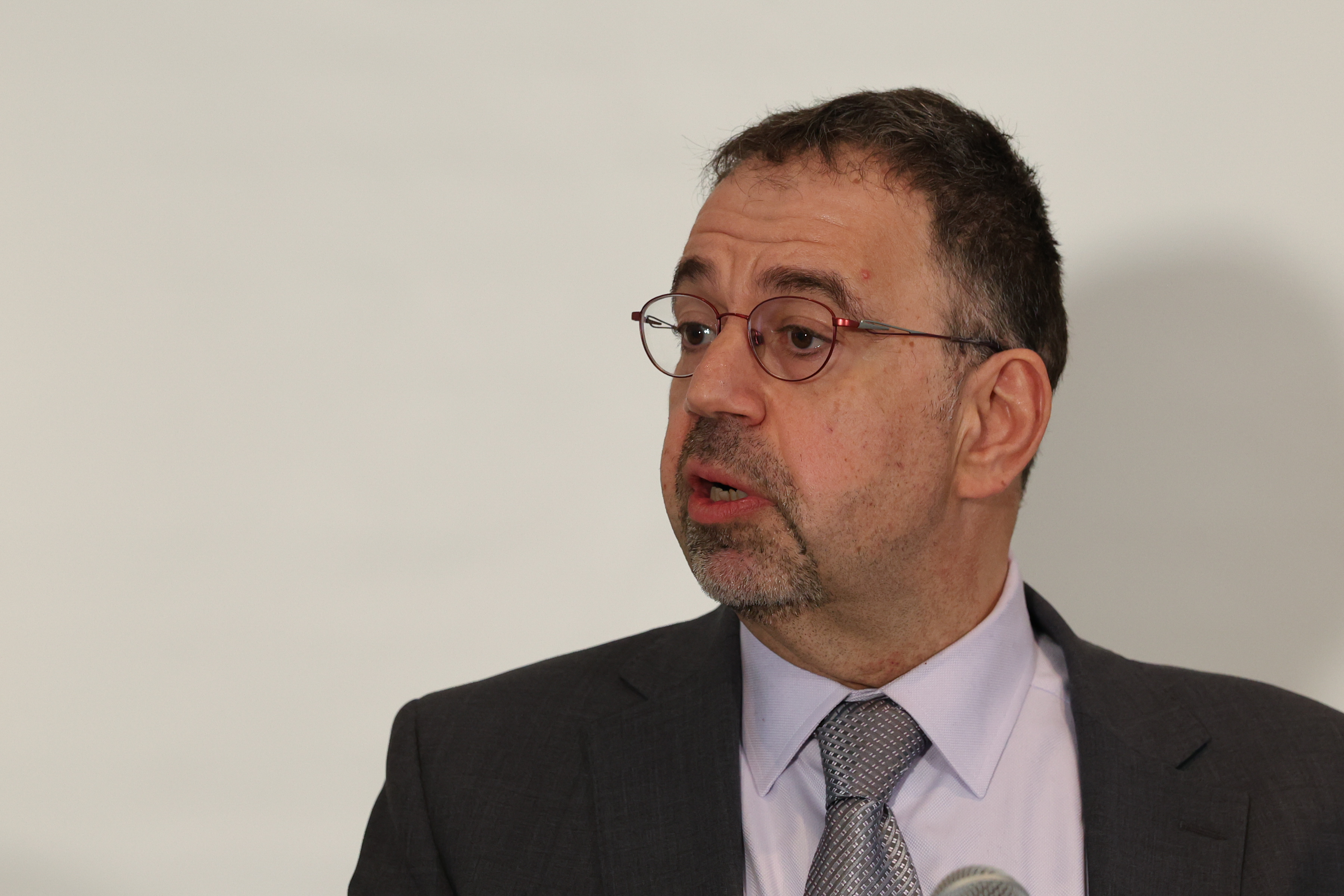
On March 21, 2025, the Clough Center’s Spring Symposium was pleased to host Youssef Chahed, the former Prime Minister of Tunisia, as a featured speaker on a panel entitled “Paths for Democracy in the Middle East.” Chahed, who served as the head of Tunisia’s government from 2016 to 2020, drew from his firsthand experiences to explore the challenges of transitioning to democracy.

Youssef Chahed holds a PhD in agribusiness science from National Institute of Agriculture in Paris (France). A Senior Fellow at the Belfer Center for Science and International Affairs of the Harvard Kennedy School, he works with the Middle East Initiative (MEI) and will be a Visiting Scholar at the Clough Center during the 2025-2026 academic year.
In his remarks, Chahed discussed the main challenges that Tunisia faced after the revolution in 2011, which helped lead to the so-called Arab Spring. Today, in the aftermath of those upheavals, he said, many ordinary people in the Arab world are drawn to strongmen. However, he suggested that this is not necessarily exceptional, given the rise of populist figures elsewhere around the globe.
Chahed pointed out that Tunisia saw the rise of Political Islam in the aftermath of the revolution in 2011. This was evident also in Egypt, where the Muslim Brotherhood came to power. In addition, Tunisia had to face economic difficulties. For instance, in response to terrorist attacks in Tunisia, the EU posed travel restrictions to that country. Such security measures caused tourism, long a main source of revenue, to dwindle significantly.
Tunisia adopted a democratic constitution in 2014 after negotiating between major political parties and actors in the post-revolutionary period. That said, the conditions on the ground differed from the terms of the constitution. Chahed emphasized the importance of the constitution as an institution which relies on decisions of political actors. For example, in post-revolutionary Tunisia, the constitution required the government to consult with the parliament for any changes in their cabinet including the selection of judges by the Minister of Justice. It was a deficit that undermined the government.
the rules of governing a country. Knowing how to run a country–that is, governance–is important if a democracy is to function, and it cannot be attained with a constitution alone. If postrevolutionary governments had kept skilled human resources from the previous regime, they could have helped run the country. A transitional justice system is important for this purpose because not everyone who worked in the former regime was necessarily corrupt; however, transitional justice failed to retain such skilled individuals. Additionally, the government miscalculated in recruiting thousands of people for the public service sector to alleviate pressure from the state’s shoulders. However, this led to a cycle of debt that undermined the economy.
The full video of Chahed’s speech is available on the Clough Center’s YouTube channel from the link below.
About The Author




Leave a Reply