
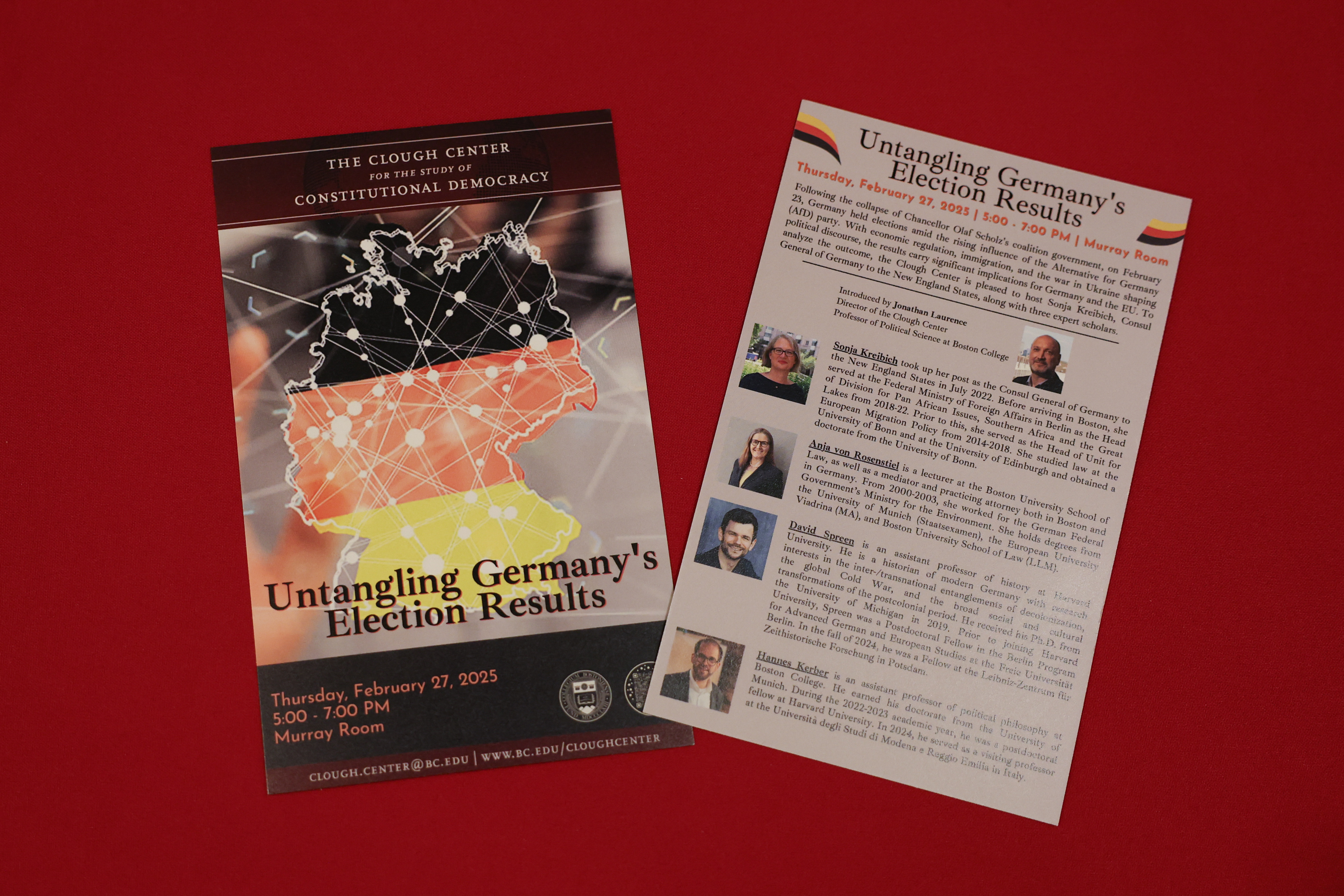
On Feb 27, 2025, the Clough Center was pleased to co-host Dr. Sonja Kreibich, the Consul General of Germany to the New England States. Dr. Kreibich discussed the outcome of the recent parliamentary elections held in Germany on Feb 23, 2025. Additionally, Anja von Rosenstiel (Lawyer and Lecturer at Boston University), David Spreen (History Professor at Harvard University), and Jonathan Laurence (Political Science Professor at Boston College) participated as co-speakers in the discussion with Dr. Kreibich. Hannes Kerber (Political Science Professor at Boston College) moderated the panel.


Jonathan Laurence, the Clough Center Director and BC Professor, began the seminar with a brief introduction to the topic of discussion. He provided context on the trajectory of constitutional democracy in Germany in the post-World War II era. Germany has been associated with industrial power, economic miracles, foreign investment, and attracting immigrants while recovering from the destruction of war. During the 1990s, after the fall of the Berlin Wall and the reunification of West and East Germany, the country was still undergoing a transition and recovering from the trauma of Nazi rule, World War II, occupation by the Allied forces, and decades of Communist dictatorship in East Germany. Since 1948, constitutional democracy has been an unquestioned principle of Germany’s politics, alongside its commitment to human rights, a distinct separation of powers, highly federalized structures, and frequent elections. The Christian Democratic Party (CDU) and the Social Democratic Party (SDP) have alternately been the dominant parties, sometimes aligning with smaller parties to form majority coalitions.

However, in the late Cold War period, new challenges emerged for democracy in Germany, particularly due to the reunification with East Germany in 1990, which disrupted party politics. The eastern German states were absorbed, but voters were not fully integrated into mainstream parties. A key challenge was governing national identity and national sovereignty, especially in light of crises related to financial sovereignty (e.g., Germany’s responsibilities to European allies) and demographic sovereignty (e.g., the permanent settlement of Germans from the Eastern Bloc, the German-Turkish population that had arrived as laborers, and the immigration, which later led to a refugee crisis involving asylum seekers from Syria, Afghanistan, and Iraq). In this context, both left- and right-wing parties faced challenges.
Hannes Kerber, the moderator, then presented a summary of the election results, providing background on the main parties: the Social Democratic Party (which won 16.4% of the vote in the recent contests), the Christian Democratic Union of Germany (28.6%), the Greens (11.6%), and BSW (4.97%). The election was held ten months early due to the collapse of the previous government under Olaf Scholz. The government collapsed due to internal contradictions and external pressures, including Russia’s war on Ukraine, a series of mass terrorist attacks in the six months leading up to the election, and large-scale irregular immigration.
Dr. Kreibich analyzed the election results in terms of foreign policy. She stated that the outcome would not significantly impact foreign policy, including Germany’s relationship with the U.S., because the major parties share a common foreign policy approach. Therefore, she expected continuity in foreign policy. Regarding the influence of social media, she noted that statements on social media did not have a significant impact on the election results. While concerns about foreign interference—particularly from Russia—existed, Germany effectively monitored and safeguarded the elections.
Anja Von Rosenstiel discussed her journey as a civil society activist and how the history of Germany during the war and then the Cold War has shaped her activism. David Spreen focused on the hybrid and proportional system of election in Germany and the 5% threshold rule, which makes it incredibly difficult to gain an absolute majority. Spreen also explained the long dominance of SDU and CDU as mainstream parties. In the post-World War II period, the CDU committed to integrate the working class into a developed state and to expand a welfare system. The SPD, which is also known as the most Marxist European party before World War One, committed to deradicalization and Westernization in the 1950s, giving up revolutionary ambitions for social democratic reform.


The panel concluded with a Q&A section in which the speakers responded to the audience’s questions.
About The Author



Leave a Reply