

Junwoo Kim (PhD Candidate in the Political Science Department at Boston College): My reflections focus on two aspects. First, there seems to be a weak connection between Professor Snyder’s emphasis on the call for our reconsideration of Ukraine as something more than a nation by departing from conceiving it through an ethno-nationalistic frame, and how this new conceptualization thus should call for our greater attention and support for Ukraine winning the war, given the ideological stakes in this fight. Second, I feel that the analysis of the current war from the perspective of regional stability was absent in Professor Snyder’s talk.
First, the connection he makes between the two could rely on a number of other different factors. As he explained, it could be the relevance of Ukraine’s deep, uncovered history that has been merely treated as a myth to us. But, it could simply be geography—the location of Ukraine’s territory that could render our ideological calculus different were it not situated between great powers. In this sense, the territory as a place for people to protect retains its cultural meaning, especially if this argument logically should lead the American public to clamor for greater support for Ukraine.
Second, supporting the ongoing war by reinvigorating American arms support to Ukraine may only lead to a reduction of regional stability. The best evidence of this is when America’s position on the war gradually changed as Russia threatened Ukraine with nuclear weapons. The security implication of escalation should not be neglected—even if “I would bomb you” may turn out to be a lie—because policymakers feel a loss of their ability to deter the worst-case scenario. Increased military aid would only induce further escalation, which could ultimately threaten regional stability, with consequences of reducing global stability as well.
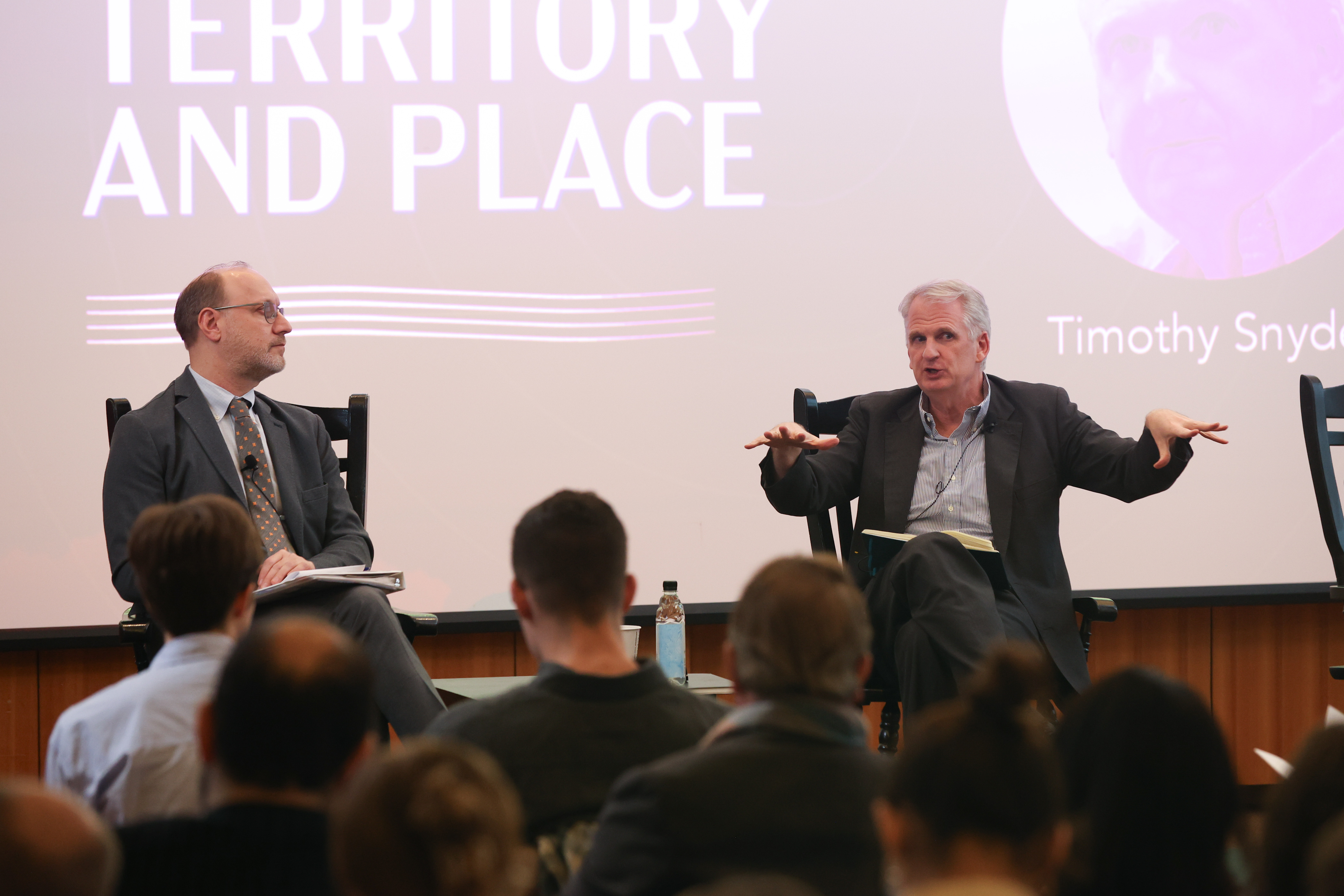
Jacob Saliba (PhD Candidate in the History Department at Boston College): The keynote lecture by Timothy Snyder generated a lot of stimulating discussion and debate. On one hand, it was hyper-focused—almost to a fault—on the historical origins of Ukraine and its impact on the contemporary war with Russia. It was clear that Snyder came to say that the war in Ukraine is worth fighting for and that the U.S. needs to support this fight unconditionally. Snyder—who himself visited Ukraine—gave many historical justifications for his message, including Ukraine’s role in facilitating the growth of Western civilization thousands of years ago, the birth of Indo-European language, and the place of Ukraine as a cultural hub and site of conflict for multiple empires from antiquity to the modern world.
On the other hand, beyond some anecdotes about Amazonian warriors that did not seem to land well with the audience and the overt political intentions of his lecture, his overarching historical argument was quite compelling and subtly argued. His basic assumption was that Ukraine’s reasons for fighting are misunderstood by today’s model of politics. He notes that in a major survey, the Ukrainian people claimed to be fighting for “territory” first and “democracy” second. Normally, we think of it as the other way around. Snyder emphasized the peculiarity of this phenomenon by saying “It’s also interesting to ask why [the Ukranians] might not think there’s a contradiction between those two things.”
To Snyder, this made historical sense. Ukraine for a long time was wedged between different empires and world powers, causing disputes over its land that led to serious bloodshed. For thousands of years, the preservation of territory was equal to the preservation of freedom. However, the motivation for fighting is not merely “nationalism” or “ethnic identity” either. The “people of Ukraine,” their “sense of place,” and their “sense of themselves” transcends contemporary interpretation. To quote Snyder, “The old nation empire thing doesn’t really work if the nation is older than the empire.” Overall, the war in Ukraine is a product of complexities, ambiguities, and histories that far outstretch modern political construction yet, ironically, also deeply ground our understanding of it today
About The Author


Leave a Reply