

Our student affiliate, Stephen Samartzis, reflects on one of our keynote speakers, Loyle Campbell, a research fellow at the German Council on Foreign Relations, presentation. Read it below:
For decades, Europe’s largest economy was powered by relatively inexpensive Russian natural gas. It became known as a key economic advantage that supported its industrial competitiveness and economic prosperity. By 2021, Russia accounted for over half of Germany’s natural gas imports, and then in 2022 the full-scale invasion of Ukraine happened, and deliveries began to collapse. A relationship that once fueled Europe’s leading economy was back in the spotlight, but this time for its geopolitical vulnerability. Germany, which had been relying so heavily on Russia for its energy, needed to look in the mirror as what was once a pronounced strength was undermining its security.
Fast forward four years later, Germany faces an uncomfortable political reality. While the government has worked to reduce its dependence on Russian energy, the far-right Alternative for Germany (AfD) has advocated restoring Russian gas imports, presenting cheaper energy as a solution to economic hardship. Germany’s experience reveals a troubling paradox: in trying to reduce its reliance on Russian energy and protect its long-term security, economic pressures could push German voters toward leaders who promise cheaper energy today by restoring that very dependence.
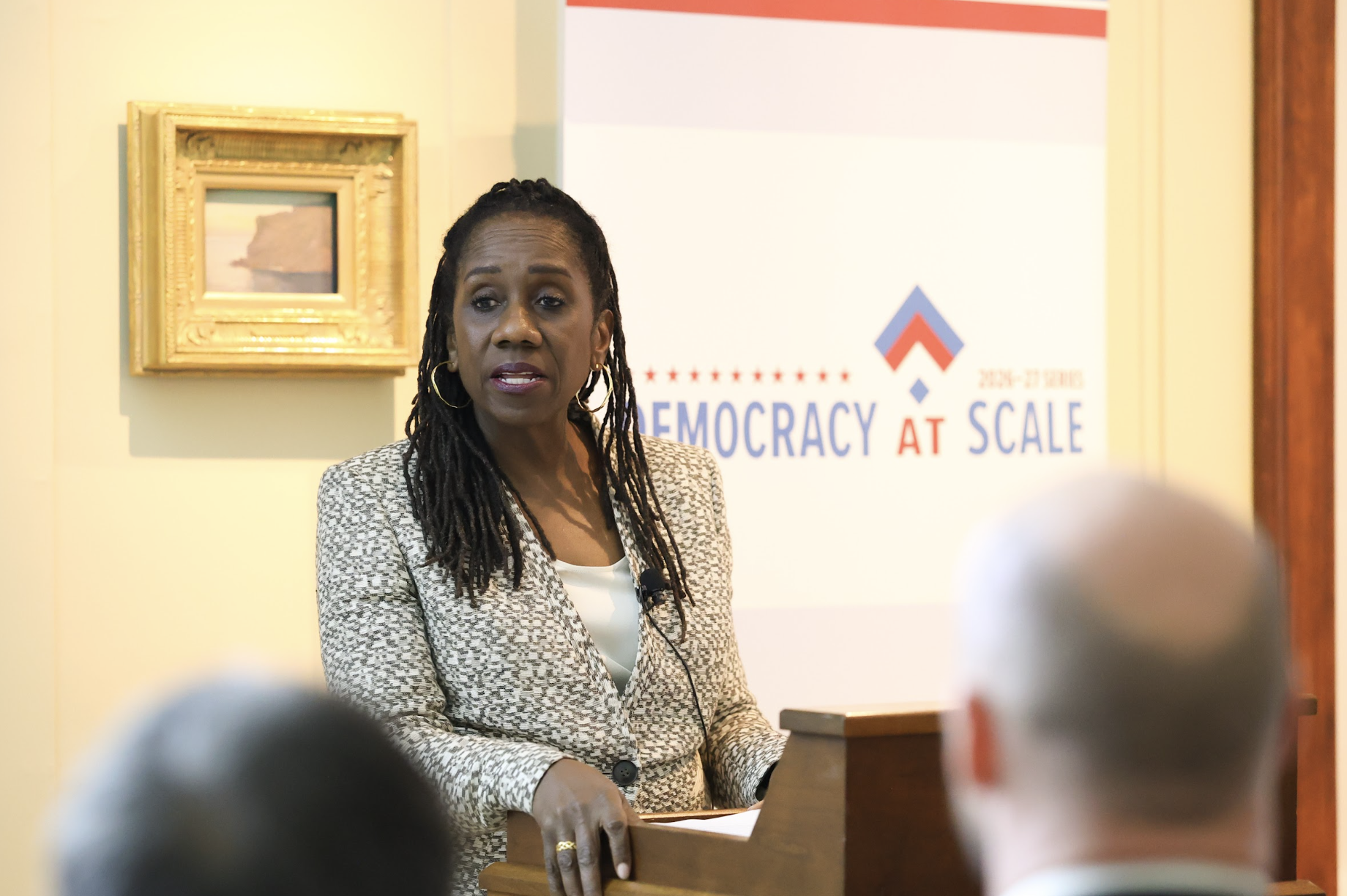
At the Clough Center’s Democracy at Scale colloquium, Loyle Campbell, a research fellow at the German Council on Foreign Relations, examined how energy insecurity can influence economic conditions, political behavior, and elections. Campbell started his lecture with the International Energy Agency’s definition of energy security: “uninterrupted availability of energy sources at an affordable price.” He pointed out that energy is crucial for economic growth because it powers homes and transportation, and it also drives industries that provide modern economies with essential services.
Campbell’s remarks come at a time of a global energy crisis, as demand has continued to grow but disruptions to the supply chain threaten to choke off the flow of energy across the world. Campbell directed the audience to the Strait of Hormuz, a critical passage for global oil and natural gas shipments, to show how disrupting nearly twenty percent of the world’s oil can send shockwaves worldwide. It begins at the gas pump, where higher fuel prices increase transportation costs. Businesses then face higher costs to produce and deliver goods, which drives up prices for consumers. As wages fail to keep pace with inflation, consumers are left thousands of miles from the cause, under immense pressure to afford everyday items.
The economy, politics, and public trust share one common thread binding them. Once it begins to unwind, the other two never take long to follow. Campbell explained how prolonged energy disruptions and economic difficulties present an opportunity for major political changes in democratic societies. His observation leads us to ask: how does a government’s inability to keep its citizens safe from rising costs influence its capacity to build public trust and pursue policy change?
Campbell offers up Germany as a prime example. As a result of the gas supply disruptions by Russia in 2022, Germany sought out alternative sources and developed more capacity to receive liquefied natural gas. This step helped stabilize the energy sector but was unable to alleviate the general economic difficulties faced by German companies. In the face of all these problems, AfD has sought to renew energy ties between Germany and Russia with the promise of cheap gas as a means to help German citizens and companies with their finances. For voters struggling with rising costs, the promise of immediate relief can be appealing. But there’s a catch: restoring Germany’s dependence on Russian energy could recreate the same vulnerabilities it has spent years trying to escape. This is the danger of a quick fix: today’s solution could become tomorrow’s crisis.
However, it would be wrong to blame Germany’s political divisions or the AfD’s growing support solely on energy prices. Immigration, economic struggles, and frustration with political leaders have also played a role. While many citizens oppose costly government policies and movements, this does not mean democracy is failing. Democracy is built on trust, culture, and efficacy. People have every right to question decisions that affect their lives, and holding elected leaders accountable is an important part of democracy.
I would argue that governments cannot protect their country’s future by ignoring the struggles of its people today. Rather than waiting for problems to arise and then reacting, governments should gradually work toward energy independence, build infrastructure, and develop new solutions before crises hit and sever ties with their providers. This would give countries more room to reduce foreign dependence without causing immediate financial troubles to the public sector. No solution is ever perfect, and there will always be costs and difficult choices, but the goal as a political leader should be to make those changes manageable for the people expected to live with them. After all, a policy meant to protect a nation’s future means little if it cannot survive the pressures of the present.
Germany’s experience reveals that energy security is about more than reducing foreign dependence. It is about building a future that is both secure and affordable for the people who must live in it. Ultimately, a democracy’s strength is not measured by the difficult decisions it makes, but by its ability to turn those decisions into lasting change without losing the trust of its people.
About The Author


Leave a Reply