

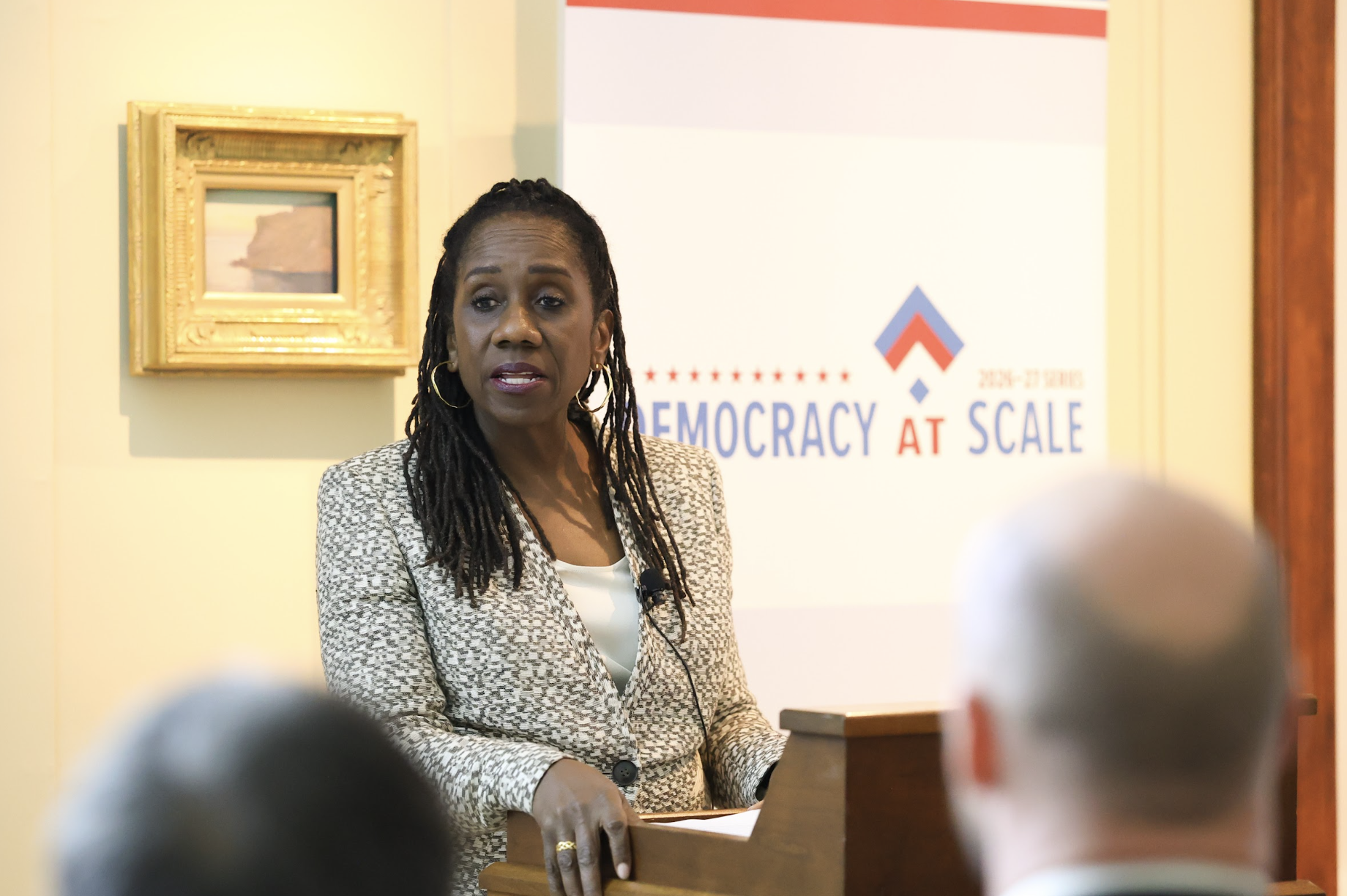
Our student affiliate, Marcus Ye, reflects on Sherrilyn Ifill’s keynote address, and adds in his own perspectives on how public spaces and goods shape our democracy, find it below:
In Sherrilyn Ifill’s keynote address, public goods were a major focus. The focus was on the ability of these public goods to inspire a shared sense of community and common bonds, which support the democratic systems of America. Ifill argues that the lack of drive to create these spaces and goods is part of why the American democratic system has begun to unravel, and importantly, it is the perception of public goods as benefiting specifically the Black community more than other communities that causes this decline in funding. And there is an immense truth to this argument. It is clear that public funding for goods and services is in decline, and, devastatingly, the public goods that are here are failing to keep their doors open. These spaces historically have acted as incubators for the American democratic process, allowing citizens to recognize each other as members of the same community, and losing these spaces creates holes that allow for the radicalization and upheaval America is witnessing today. Even more importantly, as Ifill rightly pointed out, it is the lack of access to these public spaces that creates the void America is facing today.
While the creation of these goods is undoubtedly an important aspect, access to these spaces for all is the crux of the issue. The question is a simple one: Who gets to use these spaces? Should it only be the citizens of a particular state? Should it be the taxpayers? Anyone who has funded the project? Or rather, should there be no conditions attached? The answer should be the latter. In order for public spaces to achieve the goals that they set out for themselves, public space access must not be contingent on socioeconomic standing, citizenship, or race. It is not enough to create public goods; rather, access should define conversations about these spaces. America has a history of creating public services that have historically restricted access for marginalized groups.
It is no secret that this was an intentional act by government officials in the 1950s and 1960s to prevent Black residents from receiving an education in schools, for example. Other forms of exclusion include “anti-homeless” benches in cities that employ physical barriers such as railings. Indeed, if the purpose of these spaces is to cultivate a shared perspective, an understanding among people from different backgrounds, then the exclusion of these groups serves to constantly undermine this goal. These barriers fundamentally remove any hope of public spaces being places of community, and worse, they only serve to exacerbate the differences between Americans. When individuals are separated into groups without diversity, they lose the ability to recognize the struggles and experiences of another. Most dangerously, this separation creates indifference toward one another, perpetuating a cycle of apathy. Seeing no need to help those who are not in their immediate community, individuals begin to view public services not as services for all, but as services for them and specifically, for their communities.
This indifference is what lies at the heart of the decline of public services and goods and, broadly speaking, democracy in America. When this level of insulation from others occurs, the result is not just the loss of individual perspectives but also a decline in critical thinking. More acutely, the use of language is the clearest symptom. Individuals no longer see one another as humans, but rather as outsiders. Ifill is completely right on this point when she mentions the stigma around the word “public” and racialized language, and to extend this further, the stigma also exists in relation to economic and socioeconomic prejudices.
To highlight this point, refer to the example of SNAP. Born out of an intention to help low-income Americans in times of need, it has slowly become wrapped in a whirlwind of stereotypes. Often, it has been the target of ridicule by politicians, who associate it with ideas of “laziness” and “freeloaders.” Beyond the dehumanizing and exclusionary language, it reinforces the idea that SNAP recipients are different, that they are somehow less members of the community than others, hence the numerous calls for funding cuts to SNAP in the present. (4) But ask this: would another SNAP program improve the situation? Or would it simply be passing the buck? The issue is not a failure to create public services but a failure to recognize whom those services are for. It is not for “freeloaders,” but for members of the community. For the single mothers who rely on SNAP to fund their children’s groceries, for fathers who work to put food on the table for their children, and for children who rely on the government for their free lunch at school.
Thus, it is clear: in order to create more public goods and services, the conversation must start from a place of compassion. It must come from a place of humanity. Recognizing and seeing the humanity in others: that is the real public good.
About The Author


Leave a Reply