
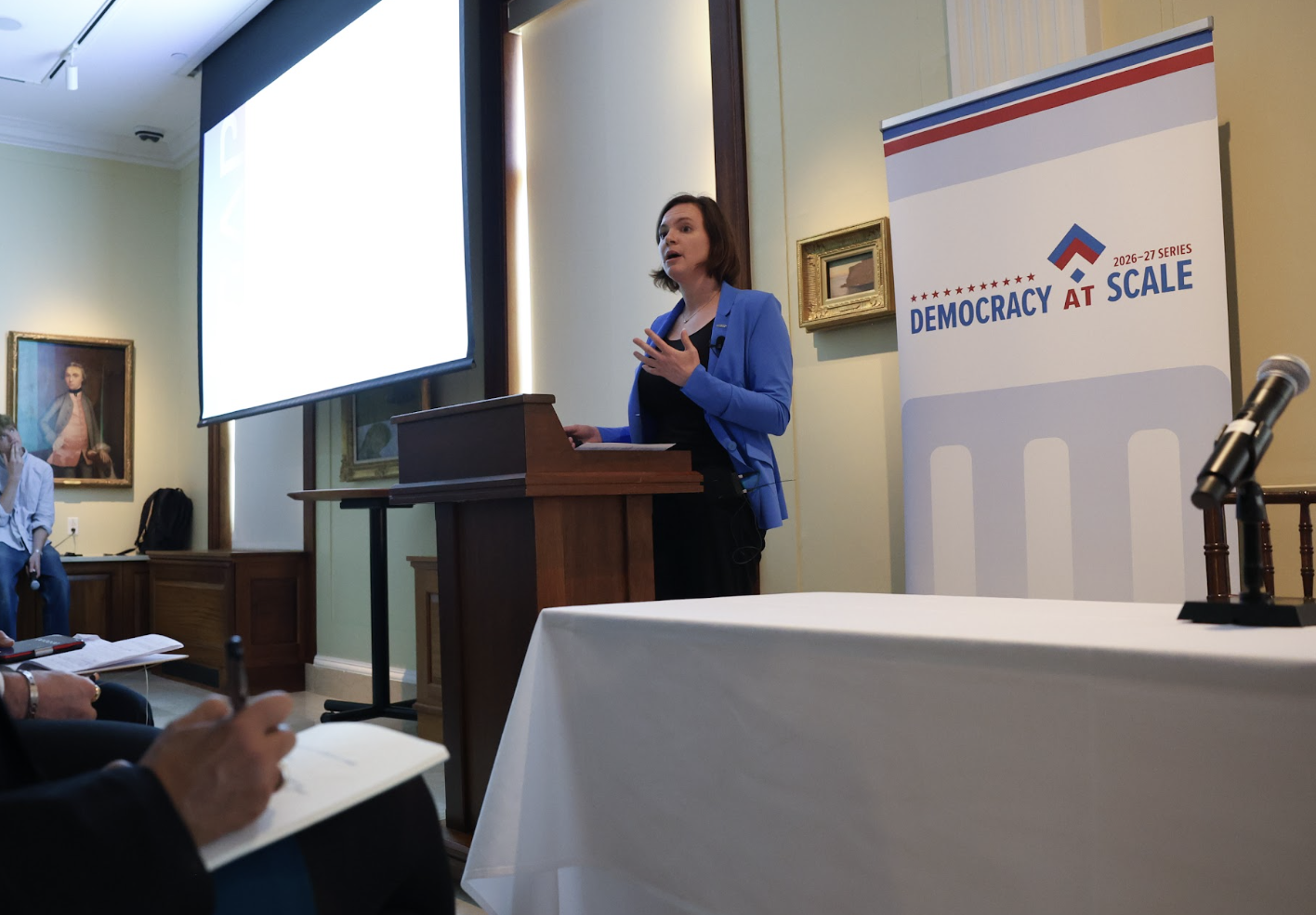
Our student affiliate, Griffin Noumair, reflects on Isabelle Schäfer’s compelling presentation as one of our keynote speakers of this years Fall Colloquium, read it below:
A spike in the price of gasoline may begin with a disruption thousands of miles away. A labor shortage in a German state may lead its officials to negotiate directly with a foreign government. Neither situation fits neatly into the familiar picture of democracy: citizens elect representatives within defined borders, and those representatives govern on their behalf. Yet at the Clough Center’s Fall Colloquium, DGAP research fellows Isabelle Schäfer and Loyle Campbell described a world in which the boundaries of government and the boundaries of political problems increasingly diverge. Their presentations on migration diplomacy and energy security raise a difficult question: How can citizens hold governments accountable when the causes of the problems they face, and the institutions responding to them, extend well beyond their borders? The political consequences are harder to trace, though potentially just as significant. Campbell discussed how rising energy costs have become entangled with Germany’s debates over its relationship with Russia. The Alternative für Deutschland (AfD), for example, has used energy insecurity to advocate renewed reliance on cheaper Russian gas, challenging Germany’s efforts to reduce that dependence. For households facing higher heating and electricity bills, the appeal is understandable. The costs are immediate, while the benefits of energy independence, climate commitments, and geopolitical security are often less tangible.
Of course, cheaper energy is not the only consideration. Germany must also weigh its support for Ukraine, its industrial competitiveness, and the long-term stability of its energy supply. Pursuing one objective may complicate another, and decisions that seem sensible today may expose vulnerabilities years later. Campbell emphasized how these overlapping concerns create opportunities for politicians offering seemingly straightforward alternatives. Still, dismissing public dissatisfaction as merely a response to political opportunism would overlook something important. Economic hardship is real, regardless of whether its causes can be easily explained, and voters have good reason to expect their governments to respond.
But responding to pressures that originate beyond national borders is not solely the responsibility of national governments. Schäfer’s research on subnational migration diplomacy examines how state governments have increasingly entered international affairs traditionally managed at the national level. German states, for instance, have pursued agreements with foreign partners to facilitate labor migration, often addressing workforce shortages in particular industries. In the United States, states have entered arrangements with Mexico concerning the rights of Mexican workers. Although these agreements involve matters of international concern, they frequently address problems experienced most directly at the state or local level. There is something intuitively appealing about allowing governments closer to affected communities to exercise greater influence over such matters. A German state facing labor shortages may understand its economic needs more precisely than officials in Berlin. Yet the autonomy that makes these arrangements appealing also introduces complications. Foreign policy is ordinarily conducted at the national level, in part because agreements with other countries can have consequences beyond the jurisdictions of those negotiating them. Schäfer’s preliminary findings suggest that German state-level diplomacy often complements federal objectives, while certain American cases reveal greater potential for conflict. There is no obvious point at which to draw the line between local autonomy and national coordination. Too little independence may leave local concerns unaddressed; too much may undermine policies intended to serve the country as a whole.
The competing interests surrounding migration became particularly apparent during the colloquium’s discussion of Germany and the rise of the AfD. Reflecting on the arrival of Syrian refugees in 2015 and Ukrainians following Russia’s invasion, Schäfer acknowledged the pressures migration can place on housing, education, and local infrastructure. These pressures, she emphasized, are not distributed equally. Some communities shoulder considerably greater burdens than others, even as national policy is shaped by broader demographic and economic considerations. Germany’s aging population, for example, makes labor migration increasingly important, complicating demands for more restrictive borders. A national migration policy may make sense economically while presenting very different challenges to the communities responsible for accommodating its consequences. Nor can those local difficulties simply be dismissed as political exaggerations. Schäfer acknowledged that the pressures are genuine, even if they can also be used for political purposes. Both realities can coexist.
In each case, responsibility becomes difficult to disentangle from circumstances that governments can influence but rarely control entirely. German officials cannot determine the course of international energy markets, just as state governments cannot independently resolve the economic and social pressures surrounding migration. Yet voters experience these problems through the decisions of the officials who represent them. They may blame a national government for rising prices driven partly by foreign conflicts, or fault local authorities for pressures rooted in national migration policy. Such judgments are not always misplaced. Governments still make consequential choices about preparedness, resource allocation, and how burdens are distributed.
Greater cooperation offers part of an answer, though it introduces difficulties of its own. International coordination may improve the management of migration or energy security, but placing more decisions beyond national institutions can also weaken opportunities for democratic oversight. Conversely, allowing state and local governments greater autonomy may make policies more responsive while complicating efforts to address problems whose consequences extend beyond their jurisdictions. Neither approach is inherently preferable. Much depends on whether governments can exercise their authority effectively without obscuring who is responsible for the choices being made.
There is, after all, a difference between a government’s inability to prevent a crisis and its responsibility for responding to one. Elected officials cannot be expected to control international energy markets, but they can be judged on how they prepare for disruptions, diversify energy sources, and distribute the resulting economic burdens. Similarly, while states may benefit from flexibility in international migration arrangements, the terms of those agreements and their relationship to national policy should remain open to scrutiny. Complexity should neither absolve governments of responsibility nor become an excuse for treating every undesirable outcome as a failure of leadership.
As economies and societies become more interconnected, these distinctions will only grow more difficult to maintain. Governments will continue confronting problems that extend beyond their jurisdictions, while citizens will continue experiencing their consequences within their own communities. The challenge is not simply to develop institutions capable of responding across borders, but to ensure that the decisions shaping people’s lives do not become so dispersed that responsibility for them is impossible to identify.
About The Author


Leave a Reply