
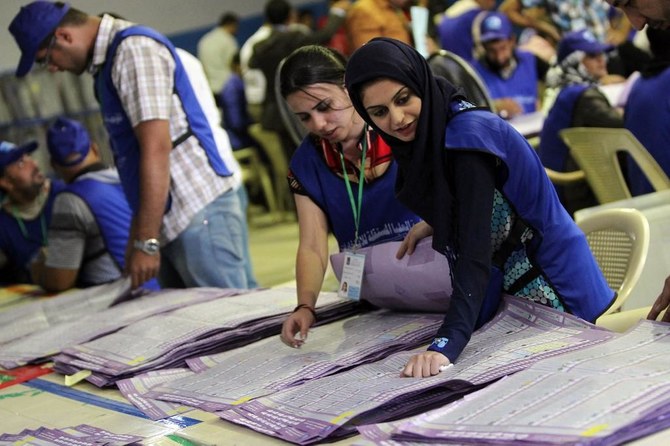
On March 11, 2025, the Clough Center hosted Professor Marsin Alshamary, a political science professor at Boston College, who spoke on modern Iraqi politics, focusing on the main parties that have shaped Iraq’s political landscape over the past two decades since 2003. This event was part of the 2025 Spring Seminar series organized by the Clough Center to explore recent elections worldwide.

Marsin Alshamary is a scholar of Middle Eastern politics with a primary focus on religious institutions, civil society, and protest movements. She is currently working on a book manuscript titled A Century of the Iraqi Hawza: How Clerics Shaped Protests and Politics in Modern-Day Iraq, which explores the historical and contemporary interactions between the Shi’a religious establishment and protest movements. Her research has been published in academic journals, including The Journal of Democracy, and she has provided commentary for various media outlets such as Agence France-Presse, Al Jazeera, BBC, The Associated Press, Vox Media, The Washington Post, and Reuters. Alshamary has also consulted for organizations like the United Nations and USAID.
In her presentation, Professor Alshamary provided an overview of Iraq’s recent elections and analyzed the conditions leading up to the parliamentary elections in 2025.
Before starting her talk, Professor Alshamary emphasized the parallel histories of Iraq and Syria. For example, Kurdish politics in Syria, particularly after the fall of Assad’s regime, relate to Kurdish politics in Iraq.
She then gave a brief history of the formation of the modern Iraqi nation-state. Iraq was established as a nation-state under the British Mandate in 1921. King Faisal I, the country’s first ruler, reigned from 1921 to 1933. However, Iraq’s monarchy was toppled in 1958 in a military coup led by the Iraqi Free Officers under Abdel Karim Qassim. In 1968, the Ba’ath Party came to power, led by Ahmad Hassan al-Bakr. The Iraqi Ba’ath Party advocated an Arab nationalist and socialist ideology, similar to its counterpart in Syria. In 1979, Saddam Hussein took power and ruled as an authoritarian until the U.S. invasion in 2003. During Hussein’s presidency, Iraq experienced some economic and social developments, such as increased literacy and education. However, prolonged wars with Iran (1980–1988) and Kuwait (1990) depleted the country’s resources.
Under Saddam Hussein, Iraq also witnessed major ethnic revolts, most notably the Kurdish uprising in the north and the Shi’a uprising in the south, both in 1991. These events shaped Iraq’s post-2003 political system, leading to power-sharing arrangements to ensure that previously oppressed groups would be protected. Iraq’s three major ethnic groups are Kurds, Sunnis, and Shi’as. However, focusing solely on these groups often overlooks the presence of minorities such as the Yazidis, Assyrians, Turkmen, and Mandaeans.
Iraqi citizens voted for the first time after Saddam’s fall on January 30, 2005, in parliamentary elections tasked with drafting Iraq’s constitution. Since then, an informal agreement has formed that the presidency is held by a Kurd, the prime ministership by a Shi’a, and the parliament speaker a Sunni. This arrangement was intended to prevent repeating the oppression of any ethnic group. Although voter turnout in the 2005 election was high (79.63%), Iraq soon descended into sectarian civil war in 2006.
Professor Alshamary then listed major political parties that gained influence after the fall of Saddam Hussein, including the Islamic Dawa Party (a Shi’a Islamist party similar to the Muslim Brotherhood), the Kurdistan Democratic Party, the Patriotic Union of Kurdistan, and the Iraqi Communist Party.
After this historical overview, Professor Alshamary analyzed Iraq’s more recent political landscape, focusing on key factions in the 2021 parliamentary elections that attracted significant public support. They represented diverse interests and ideologies.
- The Sadrist Movement: A Shi’a Iraqi movement led by cleric Muqtada al-Sadr, who is known for his strong anti-U.S. stance. He is pro-Iran at some points and anti-Iran at some other points.
- Iran-Aligned Groups: Led by Hadi al-Amiri, a member of parliament and secretary-general of the Badr Organization, a Shi’a political and paramilitary group.
- Shi’a Parties: These include the National State Forces Alliance and the Hakim Movement.
- Sunni Parties
- Activists: These include, for example, the Imtidad Movement, led by Alaa al-Rikabi.
Professor Alshamary also noted the emergence of independent candidates who have gained parliamentary seats by relying on local tribal networks. Looking ahead to the 2025 elections, she predicted a lower voter turnout, as some Iraqis may boycott the elections to delegitimize the current political system and express their dissatisfaction.
She further discussed the role of the Independent High Electoral Commission and the United Nations Assistance Mission for Iraq (UNAMI) in providing technical support for elections. However, she noted that UNAMI’s mission formally ended in 2015.
This informative and engaging talk concluded with a Q&A discussion between Professor Alshamary and the audience.
Photo Credit: AFP file photo
About The Author



Leave a Reply