
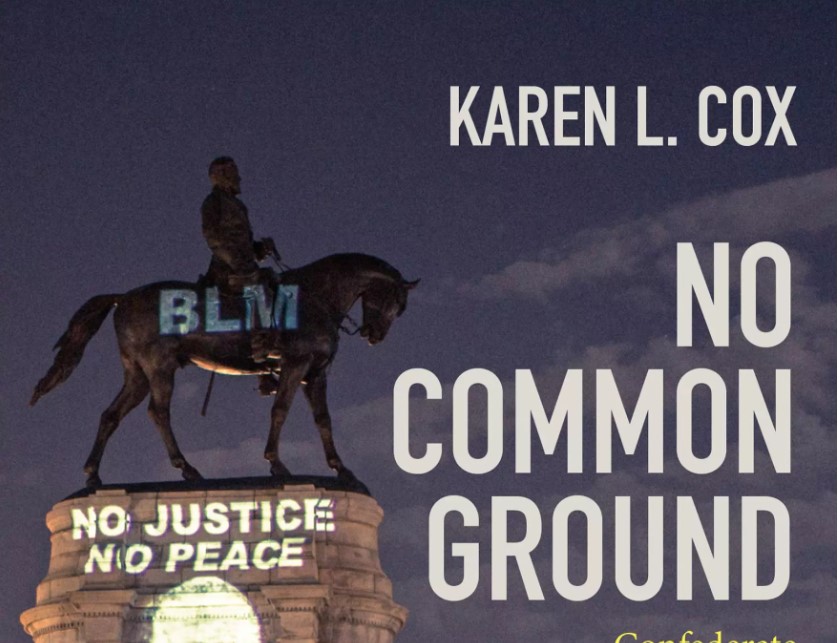
On December 7, 2023, the Clough Center hosted Professor Karen L. Cox, author of No Common Ground: Confederate Monuments and the Ongoing Fight for Racial Justice (2021), for a thought-provoking discussion as part of its Attachment to Place in a World of Nations series. This compelling event explored the deep historical roots, political struggles, and cultural conflicts that Confederate monuments embody in America today.

No Common Ground: The Struggle Over Confederate Monuments
In No Common Ground, Karen Cox delves into the heated debates and confrontations surrounding Confederate statues, analyzing both their original purpose and the modern resistance against them. Published in 2021, the book provides a comprehensive historical account of the efforts to establish, preserve, challenge, and remove these contentious monuments. Cox’s detailed narrative traces these statues’ meanings for white Southerners who erected them, portraying how they served as overt symbols of white supremacy and the “Lost Cause” mythology that followed the Civil War.
One of the book’s central arguments is that Confederate monuments were not mere memorials to the past but active, intentional symbols of racial hierarchy designed to influence the social and political landscape of the South, especially during the Jim Crow era. Cox also shows how the voices challenging these symbols, though repressed in early twentieth-century America, gained strength through the civil rights movement and beyond. Over time, civil rights activists, African American politicians, and local communities pushed back, sparking widespread calls to remove these monuments and reclaim public spaces.
In addition to these insights, Cox delves into recent legislative and political efforts to defend Confederate monuments, revealing the strategic use of “heritage” laws, gerrymandering, and other mechanisms to hinder removal efforts. This ongoing struggle between preservation and removal demonstrates how deeply intertwined these monuments are with the nation’s unresolved racial history. Cox argues that their presence—or absence—sends a message about what stories America chooses to uphold and what values it wants to project.

About the Author: Karen L. Cox
Karen L. Cox, a Professor of History at the University of North Carolina at Charlotte, is a renowned scholar of the American South, race, and popular culture. Her work has earned her a reputation as an authority on Confederate monuments and Southern identity, making her a sought-after commentator on these topics in national and international discussions. Alongside No Common Ground, Cox’s acclaimed books include Dixie’s Daughters: The United Daughters of the Confederacy and the Preservation of Confederate Culture (2019) and Dreaming of Dixie: How the South Was Created in American Popular Culture (2019).
Cox has also contributed her expertise to major publications, including The New York Times, Washington Post, TIME, and Smithsonian Magazine. She has appeared in high-profile documentaries, such as Henry Louis Gates’s Reconstruction: America After the Civil War and the Emmy-nominated The Neutral Ground. Her dedication to public scholarship reflects a commitment to advancing public understanding of complex and often contentious issues in Southern history and beyond.


The Event and Respondent
Moderating the event was Nir Eiskovits, Professor of Philosophy and Founding Director of the Applied Ethics Center at UMass Boston. Known for his work on wartime ethics and transitional justice, Eiskovits brought a philosophical dimension to the conversation, enhancing the discussion of how history, ethics, and cultural identity intersect in the ongoing debate over Confederate monuments.This Clough Center talk underscored No Common Ground‘s relevance as a text that not only examines the past but also challenges us to reflect on the narratives we preserve and the spaces we inhabit. As the concluding event of the Clough Center’s fall program, Cox’s lecture encouraged the audience to grapple with the implications of public memory and racial justice in shaping the American landscape.
About The Author




Leave a Reply