

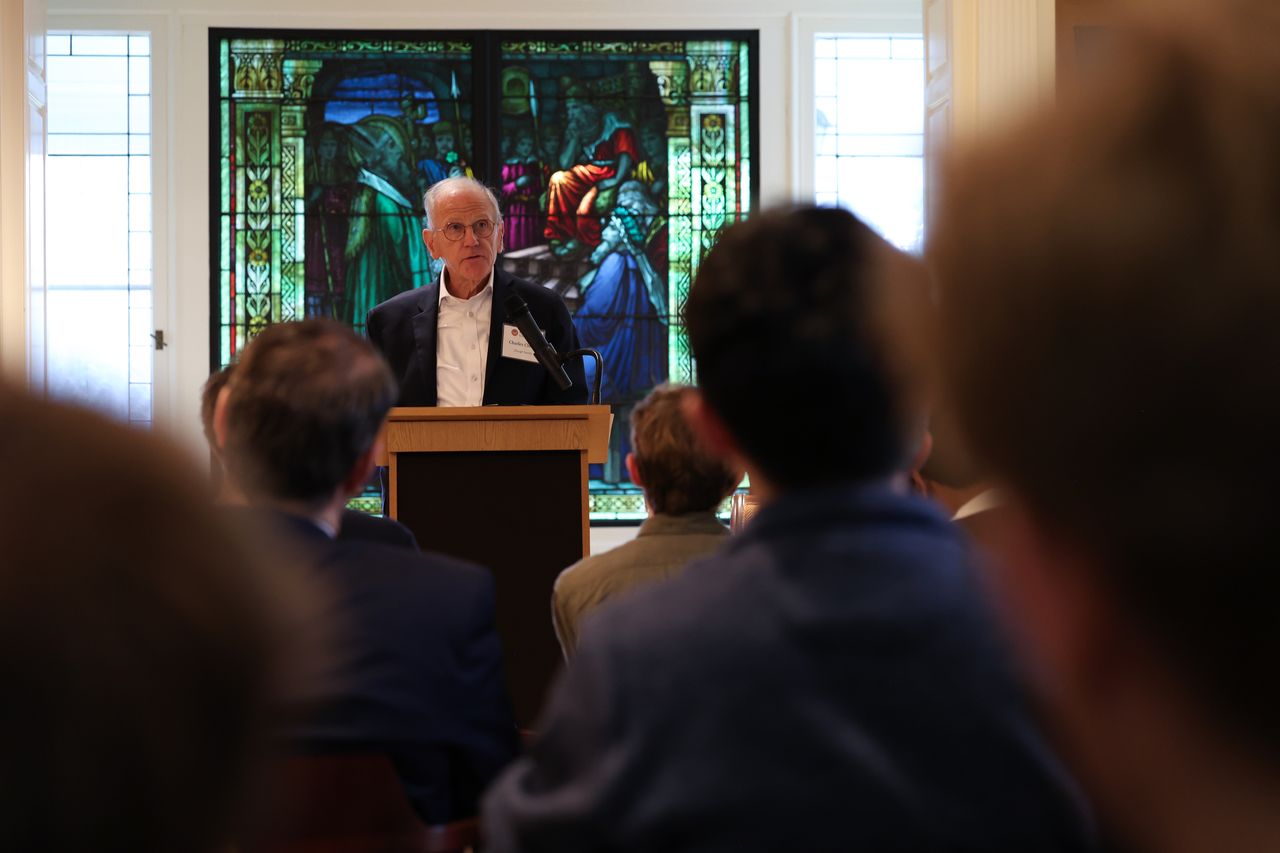
On November 6, 2025, the Clough Center hosted a panel discussion featuring Dr. Mohammed Hashas and Dr. Youssef Chahed to explore the trajectory of democratic institutions in North Africa with a focus on Morocco and Tunisia. Mohammed Hashas is a preeminent scholar of Moroccan intellectual history, religion, and politics in the Arab-European Islamic world at large. Hashas is the editor of Contemporary Moroccan Thought (2025), a groundbreaking volume that reflects modern Morocco’s intellectual history. Youssef Chahed served as the Prime Minister of Tunisia from 2016 to 2020. During his tenure, Prime Minister Chahed took actions against terrorism and worked for racial and gender equality.
Dr. Jonathan Laurence, Clough Center Director, began the panel by introducing the speaker to the audience and providing a brief overview of the recent political shifts in North Africa. Professor Laurence pointed out how the politics in North Africa have evolved since colonialism to the Cold War. Over the past decades, particularly after the fall of the Berlin Wall in 1989, the region has experienced two major periods marked by the hope for democratization: the early 2000s, when the US administration under George W. Bush tried to promote democracy, and the 2010s, when the Arab Spring fueled hopes for democratic transitions. This introduction laid the ground for the panelists to start their discussions.


Hashas divided his speech into three main parts. In the first part, he introduced the main intellectual figures who grounded the idea of democracy in Moroccan politics during the modern era, such as Allal al-Fassi, Muhammad al-Zayani, and Muhammad Abid al-Jabiri. Hashas underscored the significance of the philosophical foundations of democracy. Then, he explained that Morocco has witnessed four main historical phases of democratic changes since the early 20th century.
- First phase: Morocco turned into a French protectorate in 1912, during which the Moroccan nationalist movement emerged, lending support to democratic institutions.
- Second phase: Morocco gained independence in 1956 and inaugurated its first constitution in 1962, which formed a two-chamber parliament and allowed political pluralism. This democratic period did not endure because of two attempted coups in 1970 and 197x, which resulted in suspension of the constitution by the monarch.
- Third phase: From 1972 to 1999, Morocco experienced a mixture of authoritarianism and constitutional improvements. In 1996, Morocco adopted a new constitution in the context of post-Cold War neoliberal reforms and domestic economic difficulties. In 1998, the Socialist Union rose to power, which collaborated with the monarch. To some onlookers, this collaboration looked like an opportunity for democracy.
- Fourth phase: The Arab Spring in 2010-2011 marked a turning point in Moroccan political developments. In response to the protest movements, the Moroccan monarchy proposed the formation of a new constitution. While the monarch maintained authority, it enhanced power sharing with the parliament.


Despite the constitutional reforms after the Arab Spring, the socioeconomic conditions have posed the main challenge to democratic institutions in Morocco. Hashas concluded his speech by addressing the political and economic factors that can influence the future of democratic shifts in the country.
Next, Youssef Chahed continued the panel with a focus on the post-Arab Spring evolutions of democracy in Tunisia. After the fall of Zine El Abidine Ben Ali in 2011, Tunisia started a democratic transition, while facing challenges, including the vacuum of power, terrorism, and discord between the opposition parties. In 2013, four main civil society organizations convened and reached an agreement called the National Dialogue Quartet, which helped to overcome the conflicts and paved the way for the establishment of the first post-revolutionary constitution in 2014.
Chahed highlighted the importance of pre-revolutionary institutions that facilitated the transition to the constitution of 2014, such as a non-Islamist civil society and women’s rights reforms. Also, Tunisia had a history of reformist and moderate Islamic parties that cooperated in this process. However, after the 2014 constitution, the concentration of power by Islamist parties gradually adopted an exclusionary approach, and the governments did not have the determination and capacity to respond to public demands. Although Tunisia’s democracy lasted longer than democratic transitions in Egypt and did not end up in civil conflicts like those of Libya, the Islamist parties tended to monopolize power and did not pay attention to the economic conditions. This resulted in popular disillusionment and prepared the return of authoritarianism.
This panel concluded with a discussion between the speakers and the audience during a Q&A session at the end of the event. You can watch the full video of it via the Clough Center’s YouTube.
About The Author



Leave a Reply