
One of our Visiting Fellows, Andres B. Munos-Mosquera, has co-authored an article for the Wall Street Journal. Read it bellow:
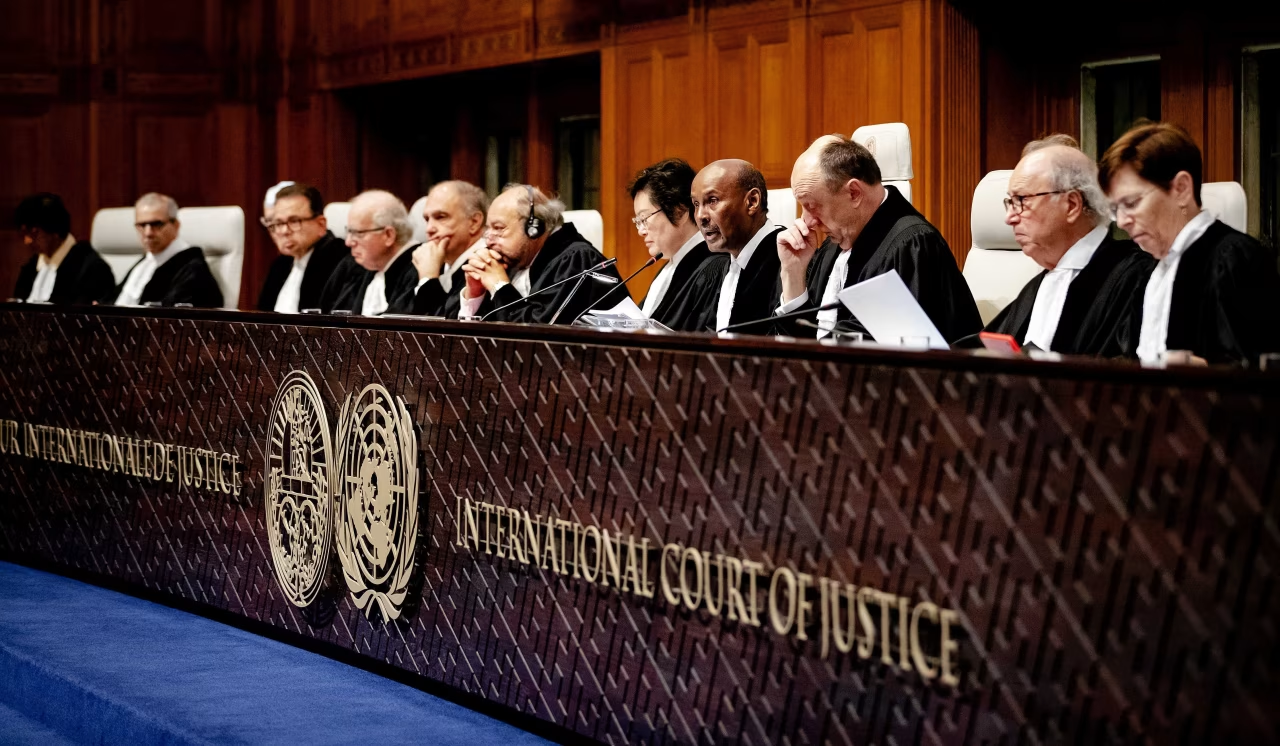
The Trump administration is working to dismantle the International Criminal Court. But a different tribunal, the International Court of Justice, could become a greater threat to the security of the U.S. and its allies. The ICJ is deciding a case, Gambia vs. Myanmar, that could drastically lower the legal threshold for genocide.
This is the express goal of some advocates, since it would pave the way for a genocide finding in South Africa’s pending case against Israel. The lower threshold would also unleash genocide claims against the U.S., other North Atlantic Treaty Organization members and their officials in international courts. It would do so in foreign courts, too, as at least 90 countries have enacted “universal jurisdiction” over genocide allegedly committed abroad by foreigners against foreigners.
Pressing the ICJ to lower the standard are the overlapping Gambian and South African legal teams. Central to the effort is Navi Pillay, appointed by Gambia as ad hoc judge in its case. Ms. Pillay, a South African, chaired a United Nations commission that in 2025 claimed Israel committed genocide in Gaza. South Africa brought its ICJ case even though Israel’s conduct hasn’t met the current definition.
The Genocide Convention requires proof of “intent to destroy, in whole or in part, a national, ethnical, racial or religious group as such.” Under past ICJ cases, genocidal intent can be proved directly through evidence of a “genocidal plan” or inferred from a “pattern of conduct.” But when intent is inferred, intent to destroy the group “must be the only reasonable inference which can be drawn from the pattern of conduct.”
Key submissions in the Myanmar and Israel cases urge the ICJ to replace that clear, high standard with a vague, politically malleable one: a range of “facts and circumstances” assessed “comprehensively and holistically.” Adopting a standard inconsistent with the Genocide Convention would exceed the ICJ’s judicial role, transforming it into a legislative body rewriting the treaty.
Lowering the threshold is unnecessary to find Myanmar committed genocide. Myanmar’s forces reportedly perpetrated repeated mass executions of Rohingya civilians, including dozens of children, lining them up and shooting or hacking them to death. Myanmar says these operations countered terrorism.
In this case, genocidal intent is the only reasonable inference. This differs factually and legally from civilian deaths incidentally caused by Israeli strikes targeting Hamas fighters, particularly given Israel’s precautions and Hamas’s documented use of human shields.
The timing is important. The Myanmar judgment, expected in October, would establish the lower threshold before the ICJ judgment on Israel. It would change the rule first in the less-watched case against Myanmar rather than seemingly invent it for Israel.
Activists are particularly eager to lower the standard because genocide is often the ICJ’s only practical jurisdictional hook for intervening in a war. Unlike the Genocide Convention, neither the Geneva Conventions or other law-of-war treaties provide the ICJ with any jurisdiction. As one leading ICJ litigator explained, “war crimes or crimes against humanity cannot be brought before the [ICJ] because the court has no jurisdiction,” forcing the applicant to “shoehorn” claims into genocide, because “it’s genocide, or it’s nothing.”
Recent ICJ decisions heighten the incentive by allowing any Genocide Convention member with ICJ access to receive a “provisional” order restricting another member’s military campaign without itself suffering tangible harm and before the court has found even a plausible case that the campaign is genocidal.
The inevitable avalanche of ICJ genocide cases will exploit the court’s structural weaknesses. Studies show ICJ judges’ decisions correlate with their home countries’ United Nations General Assembly votes. The ICJ can issue orders only to nations, not terrorist groups. Its provisional measures restricted Israel’s military while acknowledging it had no authority over Hamas. NATO members would face the same asymmetry against other terrorist groups.
The U.S. claims its reservation shields it from ICJ genocide jurisdiction. But key allies question that—as do an increasing number of ICJ judges. Regardless, ICJ decisions are treated as authoritative statements of international law standards by U.N. agencies, the ICC and foreign national courts. So a lower standard would inevitably help weak genocide claims gain traction against the U.S. in those other venues.
China already extensively uses foreign-court lawfare against critics. A campaign secretly driven by China could use the lower genocide standard to launch lawfare against U.S. and allied officials in foreign courts claiming universal jurisdiction. These genocide cases would burden rule-of-law democracies more than autocracies. Even weak genocide claims could severely affect NATO. Meanwhile, the war-crimes warrant for Vladimir Putin has had little effect.
ICJ judges who vote to lower the genocide threshold will damage the court’s credibility, invite an avalanche of politicized cases, and undercut democracies’ ability to fight terrorists and autocrats. The Trump administration will likely respond by imposing sanctions on the judges, as it has already done to ICC officials.
Mr. Kittrie is a law professor at Arizona State University, a senior fellow at the Foundation for Defense of Democracies and a former State Department attorney. Mr. Munoz-Mosquera is a distinguished scholar at Boston College. He served as chief legal adviser to the North Atlantic Treaty Organization’s supreme allied commander, 2014-25.
About The Author



Leave a Reply