
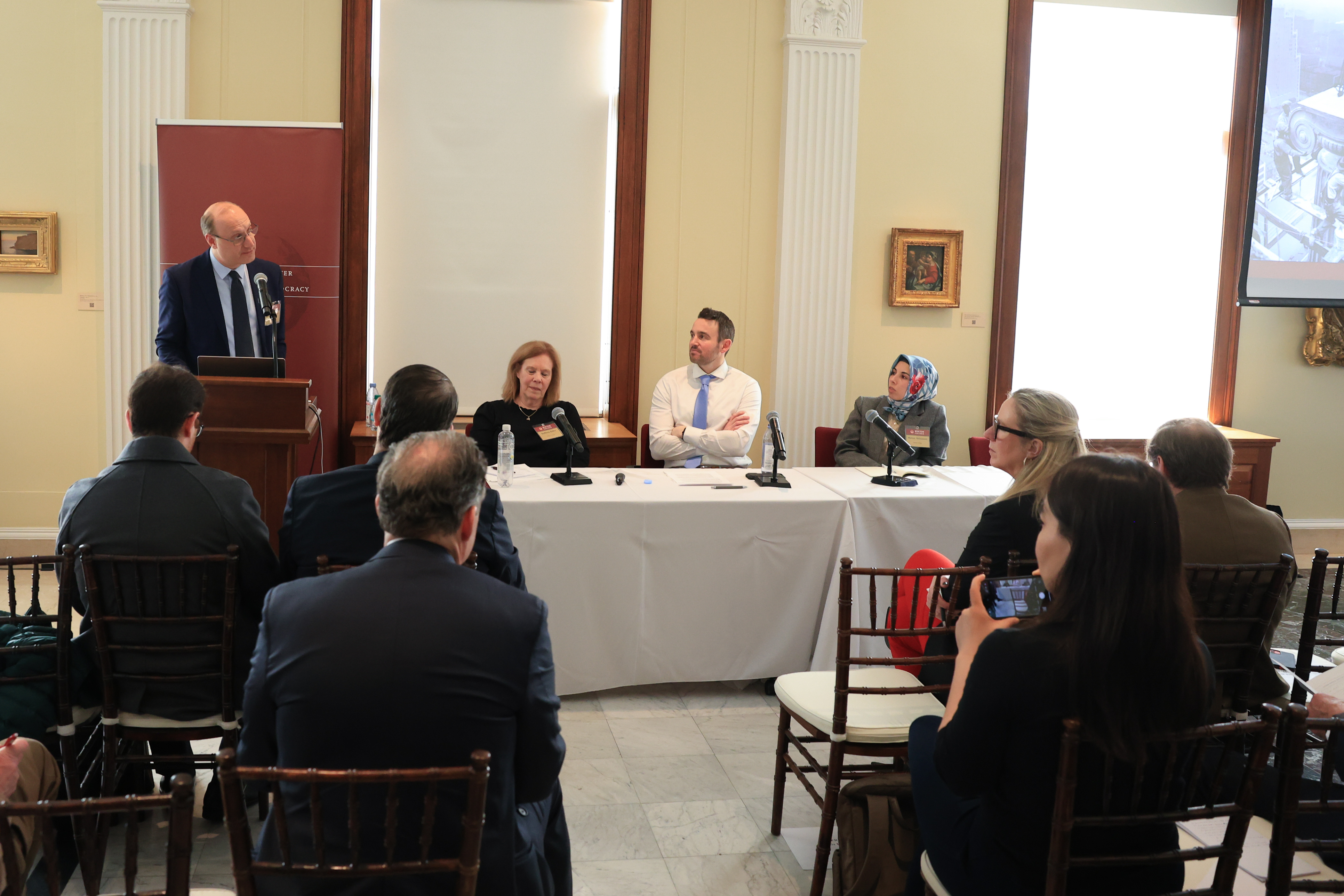
On Mar 21, 2025, the Clough Center’s Spring Symposium hosted a panel, What Paths for Democracy in the Middle East?, to consider the challenges for democracy in this region. Peter Krause (Political Science, Boston College) and Marsin Alshamary (Political Science, Boston College) served as co-speakers, while Kathleen Bailey (Political Science, Boston College) served as the moderator.
Bailey began the discussion with a brief mention of the political upheavals in the region, from the Arab Spring in 2011 to the current conflict between Israel and Hamas. She emphasized the region’s complexity in terms of both politics and geography.

Alshamary particularly covered the challenges of democratization in Iraq, Syria, and Lebanon:
- Iraq: Iraq, she noted, is a federal democracy and has held multiple elections for parliament and the presidency since 2005. Although the impacts of war continue to exist, Iraq has made significant progress in freedom of speech and a fair election system, in addition to resolving sectarianism.
- Syria: Syria, Alshamary explained, has experienced six decades of authoritarianism, including violent coups. But it now has an opportunity to build up democratic institutions after the fall of the Assad regime. That said, predicting a democratic transition in Syria is complicated, as the country is currently experiencing a security vacuum. Moreover, it has gone through thirteen years of civil war since 2011. Another key issue in Syria is the position of various armed groups.
- Lebanon: Finally, regarding Lebanon, Alshamary depicted the prospect for democracy as severely impacted by the recent war with Israel, an ongoing financial crisis, and the two-year constitutional crisis from which it has just emerged.

Peter Krause continued the discussion of democracy in the Middle East with a focus on Israel and Palestine. Krause raised serious concerns about the future of democracy in the region, given the escalation of the current war. He pointed out that the status of democracy in both Israel and Palestine is at its lowest point. Krause, then, followed up with evidence regarding the main challenges to democracy in both cases.
- Israel: Israel, before the October 7 attacks, was already experiencing multiple democratic challenges. Krause mentioned the street protests in Israel and touched on the issues of political stability. He mentioned that Israel held five elections within only four years from 2019 to 2023. The elections were fair and free. However, the frequency of elections in a short period indicates an increase in political polarization because no coalition could form a stable majority. Furthermore, after the October 7 attacks, the state did not establish a Commission of Inquiry to investigate the intelligence failures, unlike what had happened after the Yom Kippur War in October 1973. Krause recognized the threats to the Supreme Court and the lack of institutions such as the Commission of Inquiry as some of the problems with the status of democracy in Israel.
- Palestine: Palestinians did not have democratic institutions in the early years of their movement, but over the past years, they held two national elections: in 1996 and 2005-6. Krause recognized Mahmoud Abbas as the main obstacle to elections because Abbas is unwilling to give up power. Krause related this problem to the lack of a free press and institutions to hold their leaders accountable. Therefore, the Palestinian Authority censors the media and cracks down on protestors. Also, Krause highlighted the lack of checks and balances within the Palestinian Authority. Krause mentioned the poll results, which show that people want elections, but public trust in the government is low because of corruption in the political leadership.
This discussion was concluded with some remarks about the generational changes in the Middle East, who are more inclined towards peace and democracy. You can watch the full video of this panel discussion, including Q&A, via the link below on the Clough Center’s YouTube channel.



Leave a Reply